Employee Engagement Program
Program Overview
The California Department of Human Resources (CalHR) Benefits Division prioritizes empowering every employee throughout the State of California to thrive. Through the Statewide Engagement Program also known as You Matter, we bring together a suite of initiatives designed to support your wellbeing, growth and recognition:
- Live Well through the Employee Wellness Program
- Support the Whole You with the Employee Assistance Program (EAP)
- Celebrate Your Impact through the Merit Award Program
- Thrive Together with Employee Engagement Program efforts
Together, these programs foster a workplace where every individual feels valued, supported and inspired to grow, enhancing the overall employee experience at every stage of their journey.
Employee engagement is as essential as health or dental insurance because all three directly protect organizational health and human wellbeing. However, engagement operates at a deeper and more widespread level. Employee engagement addresses the psychological, relational and performance conditions that determine whether people thrive or merely survive at work.
Thrive Together, the state’s Employee Engagement Program, is led by CalHR with partnership from Gallup. Gallup is a leading thought partner in employee engagement and organizational performance research. Gallup brings decades of expertise in studying what makes workplaces thrive, from developing the Q12 engagement assessment, to identifying the science behind strengths-based development and the five elements of wellbeing. CalHR strives to ensure employee engagement is threaded throughout the state’s benefits. Employee engagement isn’t a “nice-to-have” metric, it’s a powerful driver of both organizational success and personal wellbeing. When people are engaged at work, everyone benefits in multiple, measurable ways.
The Five Elements of Wellbeing
Employee wellbeing is essential for engagement and productivity. It affects how engaged and productive people are at work and in life. Gallup research shows that five areas of life shape overall wellbeing. When these areas are supported, employees are happier, healthier and less likely to feel burned out.
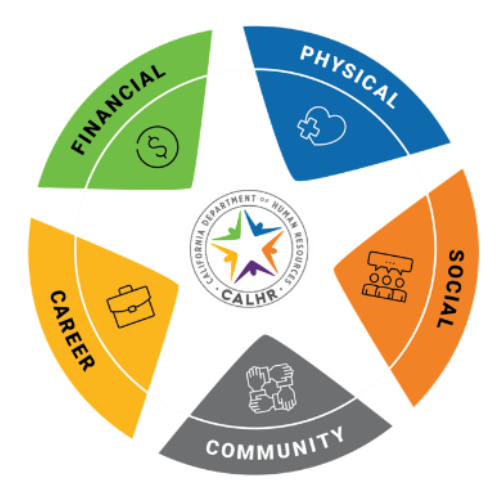
- Career wellbeing: Loving what you do every day.
- Social wellbeing: Having strong relationships and social connections.
- Financial wellbeing: Effectively managing your economic life.
- Physical wellbeing: Maintaining good health and energy.
- Community wellbeing: Feeling safe and connected to the community where you live.
These elements work together to support overall employee experience.
CliftonStrengths
CliftonStrengths is a tool that helps people discover their natural talents and turn them into strengths. Strengths encourage employees to build on what they do best. The assessment identifies 34 themes of talent that help individuals understand their unique strengths profile.
There are four main categories, called domains:
- Executing: Focuses on turning ideas into action and ensuring tasks are completed efficiently.
- Influencing: Helps teams reach a broader audience, takes charge, speaks up and persuades others.
- Relationship Building: Connects people, builds strong bonds, fosters unity and brings a team together.
- Strategic Thinking: Analyzes information, spots patterns, plans for the future and helps teams make informed decisions.
If you are interested in obtaining your CliftonStrengths, we invite you to explore CalLearns to discover courses that support and strengthen these important leadership capabilities. As we continue enhancing the statewide Employee Engagement program, state HR professionals are encouraged to reference the Benefits Administration Manual for the latest updates and guidance.
Gallup Q12 Employee Engagement Survey
The Gallup Q12 survey asks 12 questions that show how engaged employees feel at work:
- I know what is expected of me at work.
- I have the materials and equipment I need to do my work right.
- At work, I have the opportunity to do what I do best every day.
- In the last seven days, I have received recognition or praise for doing good work.
- My supervisor, or someone at work, seems to care about me as a person.
- There is someone at work who encourages my development.
- At work, my opinions seem to count.
- The mission or purpose of my company makes me feel my job is important.
- My associates or fellow employees are committed to doing quality work.
- I have a best friend at work.
- In the last six months, someone at work has talked to me about my progress.
- This last year, I have had opportunities to learn and grow.
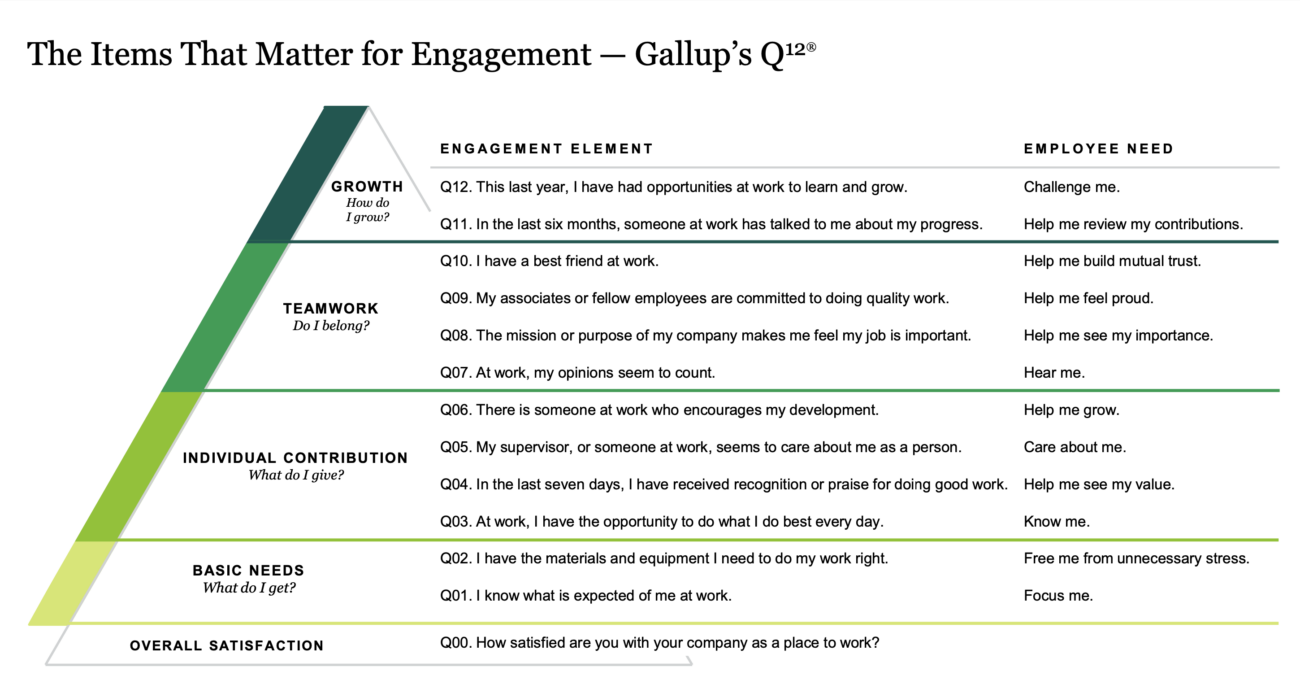
These questions build on each other like steps in a pyramid. They start with basic needs and move up to growth and development.
The Q12 items are Gallup proprietary information and are protected by law. You may not administer a survey with the Q12 items or reproduce them without written consent from Gallup. Copyright © 1993-1998, Gallup, Inc. All rights reserved.
(Q01-Q02): "What do I get?"
When you first start a job, you ask basic questions: What do I need to do? How much will I earn? Do I have the tools I need? Without clear answers to these questions, you can’t do your job well.
(Q03-Q06): "What do I give?"
Now you’re asking different questions about your work. Am I good at this job? Do others think I’m doing well? Do people care about me as a person? Will anyone help me get better? These questions are about how you feel about yourself and your work. If you don’t get good answers here, you won’t want to be part of a team or try new things.
(Q07-Q10): "Do I belong here?"
At this level, you want to know if you fit in. Do my opinions matter? Do I believe in what my company does? Do the people around me care about doing good work like I do? Do I have friends here? This is where being part of a team becomes really important.
(Q11-Q12): "How can we all grow?"
You can only reach this level after going through the earlier ones. Here, you want to improve and learn new things. You can come up with new ideas that actually work because you understand what’s expected, you feel confident in what you do (Camp 1), and you know how your teammates will react to your ideas.
Employee Engagement in State Government
Even without a formal survey, individuals can strengthen their engagement by taking time to reflect on their own needs, such as clear expectations, opportunities to use their strengths, and professional development, and then sharing those insights with their manager or taking meaningful action.
When government employees feel connected to their work, they provide better services to the public and build trust with citizens.
Only about one in four workers worldwide actually feel engaged at their jobs. Engagement matters profoundly in government because public service quality depends directly on whether employees care about their work. If Californians don’t care about their work, public services can suffer.
The good news is that improving how workers feel about their jobs brings big benefits. Government employees who are engaged:
- Do better work for the people they serve
- Feel happier in their jobs
- Stay in their positions longer
- Take fewer sick days
When California state agencies focus on making work better for employees, both the workers and the public win. Citizens get better services and employees find more meaning in what they do each day.
Engagement in government settings offers benefits that extend beyond operational metrics:
For Employees: Government workers with high engagement report significantly better wellbeing. Engaged employees are two times more likely to be extremely satisfied with their personal life and four times more likely to evaluate their condition of life as excellent.
For State Departments: Leaders can help make engagement a natural part of everyday work by:
- connecting more frequently with employees
- asking thoughtful engagement-focused questions during one-on-one conversations
- listening with intention, and
- celebrating recent successes.
Together, individuals and leaders can build regular conversation habits that highlight what’s working well, identify opportunities for improvement and explore new ways to leverage individual strengths. Most importantly, organizations can create a culture of shared accountability where everyone takes an active role in their own engagement while encouraging and supporting the growth and success of those around them.
If you want to learn more about how to implement this within your team contact: engagement@calhr.ca.gov
For Californians: According to the Gallup Management Journal, when government employees feel connected “emotionally, socially, and even spiritually to its mission, vision, and purpose,” they deliver services with greater care and commitment, directly enhancing the citizen experience.
Thrive Together
This program enhances employee engagement by empowering state employees through workplace activities and recognition initiatives. Programs include Californians Serving California and Public Service Recognition Week.
Californians Serving California
Follow CalHR’s social media web pages for monthly posts and prompts. Use #CAServingCA to connect your department’s social media efforts during Public Service Recognition Week during the first full week of May each year.